


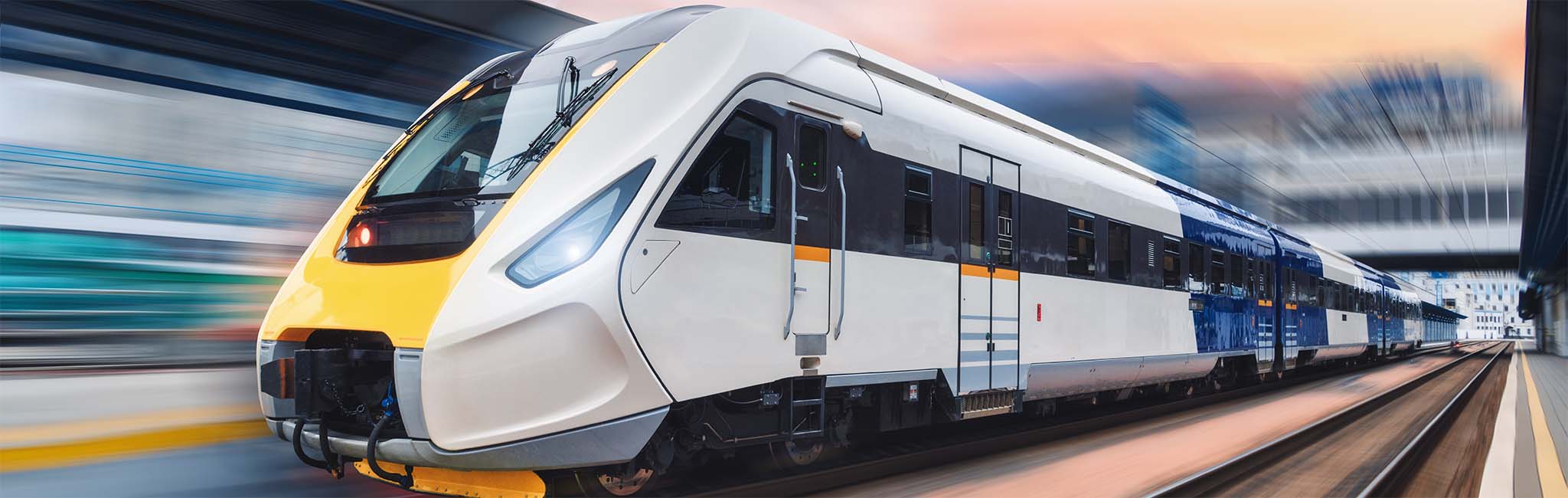
Accurate Data Acquisition Across the Entire Train
Modern trains are complex high-tech systems: high-performance traction drives, sophisticated bogies, tightly integrated control and power systems, and passenger comfort modules packed into limited space. Testing them requires data from hundreds of sensors—installed across multiple cars, from the bogie to the roof.
Centralized DAQ architectures quickly hit their limits: long analog cables degrade signals, EMI distorts data, and installation takes time and effort.
imc distributed data aquisitions systems capture signals right where they originate—synchronously across all measurement points, with robust hardware and high signal integrity. The result: a precise, system-wide view of the vehicle, without the burden of long analog wiring or susceptibility to interference.
Typical applications
- Full-train test runs and validation
- Functional testing of bogies, brakes, or HVAC systems
- Structural and fatigue measurements on car bodies
- Comfort and vibration testing (EN 14363, ISO 3381, ISO 3095)
- Thermal and climate testing
Ces méta-informations sont précisément associées aux canaux de mesure correspondants, stockées et combinées aux canaux vidéo pour former un système intégré de canaux analogiques, numériques, virtuels (calculés), de bus de terrain et multimédias. Ce "pool" complet d'informations de mesure est ensuite disponible pour une gestion avancée du stockage, une gestion de base de données et une analyse plus poussée à l'aide d'imc FAMOS ou d'autres outils tiers. Grâce à cette configuration, les experts peuvent obtenir des résultats précis, basés sur des données, pour le développement et les essais de divers composants tels que les freins, la suspension ou les systèmes de propulsion.
Pourquoi les architectures distribuées sont plus performantes
Lorsque les trajets de signal sont longs ou que l'espace est restreint, les systèmes centralisés traditionnels peinent à fonctionner. Une configuration distribuée offre des avantages évidents :
Trajets de signal plus courts – Meilleure qualité du signal
Les signaux sont numérisés à seulement quelques mètres du capteur, au lieu de plusieurs dizaines de mètres. Le résultat : une atténuation minimale, moins de bruit et une bien meilleure immunité CEM.
Jusqu'à 70 % de câblage en moins
Moins de câbles signifie moins de points de défaillance. La transmission numérique est insensible à l'atténuation et aux interférences, et les modules défectueux peuvent être isolés et remplacés rapidement.
Une fiabilité accrue
Moins de câbles signifie moins de points de défaillance. La transmission numérique est insensible à l'atténuation et aux interférences, et les modules défectueux peuvent être isolés et remplacés rapidement.
Flexibilité maximale
Les modules peuvent être repositionnés, ajoutés ou remplacés sans avoir à recâbler l'ensemble de l'installation — idéal pour les programmes de prototypage où les configurations de test changent fréquemment.
Exigences clés pour les systèmes distribués :
Distribué ne signifie pas automatiquement synchronisé ou robuste. Les ingénieurs doivent vérifier :
- Synchronisation au niveau de la microseconde
- les horodatages réseau seuls ne sont pas assez précis
- Concepts d'alimentation flexibles
- Les options d'alimentation par Ethernet (PoE) ou d'alimentation locale réduisent le câblage
- Transmission de données résistante aux interférences électromagnétiques
- Les environnements ferroviaires exposent les systèmes à de puissants champs électromagnétiques
- Contrôle centralisé
- les utilisateurs ne devraient pas avoir à gérer la complexité module par module.
Tous les systèmes distribués ne répondent pas à ces exigences — il vaut donc la peine de poser les bonnes questions.
Comment imc relève ces défis :
Fort de plus de 30 ans d'expérience sur le terrain et de centaines de projets ferroviaires menés à bien dans le monde entier, imc Test & Measurement propose des plateformes d'acquisition de données (DAQ) éprouvées pour les essais ferroviaires distribués, de l'évaluation des prototypes à la certification.
Une synchronisation précise à la microseconde près
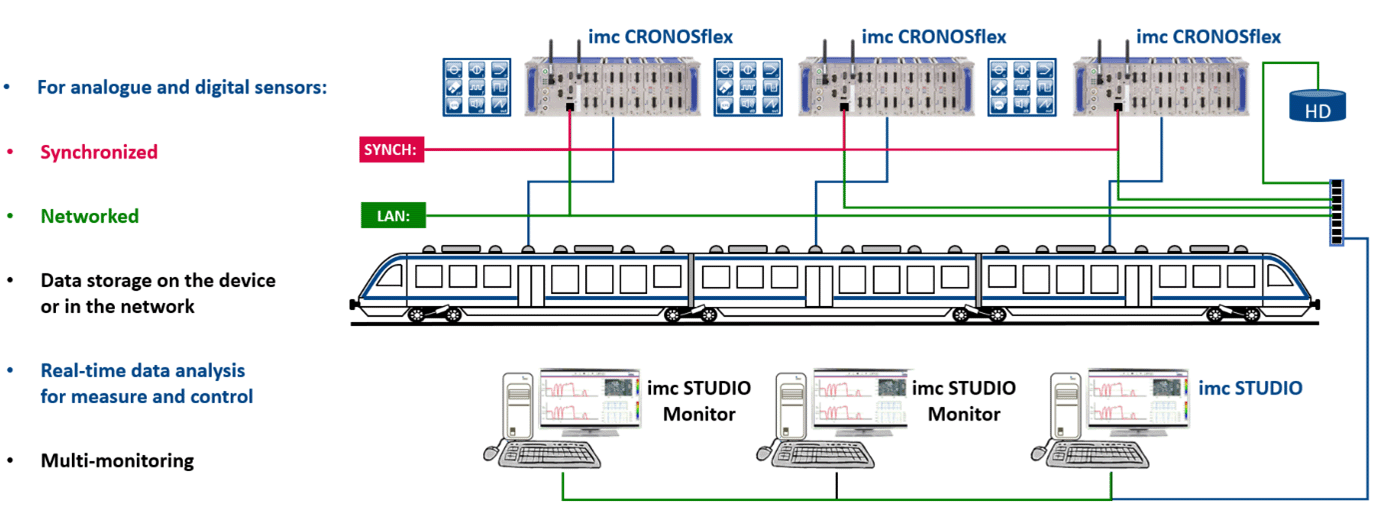
Les systèmes distribués imc CRONOSflex et imc ARGUSfit sont interconnectés via des bus haute vitesse en temps réel :
imc CRONOSflex: basé sur EtherCAT, un bus de terrain déterministe permettant une synchronisation de haute précision et un échange rapide de données sur un grand nombre de canaux.
imc ARGUSfit: utilise des liaisons par fibre optique — insensibles aux interférences et adaptées aux longues distances.
Tous les systèmes d'acquisition de données imc prennent en charge plusieurs méthodes de synchronisation :
- Synchronisation par câble pour les configurations compactes
- GPS ou IRIG-B pour les applications à longue portée
- PTP (Precision Time Protocol) sur Ethernet pour les réseaux distribués
Un processus propriétaire imc garantit une synchronisation précise à l'échantillon près sur plus de 1 000 canaux répartis sur plusieurs voitures.
Alimentation et données sur un seul câble
Les modules CRONOSflex prennent en charge le Power-over-Ethernet, acheminant l'alimentation, les données et la synchronisation sur une seule ligne. Pour les réseaux plus importants, des modules d'alimentation séparés peuvent être intégrés là où cela est nécessaire, ce qui permet de conserver une installation propre et évolutive.
Conçus pour l'environnement ferroviaire
Les systèmes imc sont conçus pour les conditions réelles du rail : résistants aux chocs et aux vibrations, avec une plage de température étendue en option de –40 °C à +85 °C (–40 °F à +185 °F) et une immunité CEM élevée. La série imc PROTECT est conçue pour les environnements d'essai les plus difficiles.
Une architecture modulaire pour chaque tâche
Avec imc CRONOSflex et imc ARGUSfit, imc propose deux systèmes d'acquisition de données (DAQ) entièrement modulaires et distribués qui peuvent être combinés de manière flexible pour répondre à toutes les exigences en matière d'essais ferroviaires. Les deux plateformes suivent le même principe : les modules de mesure sont placés à proximité des capteurs, numérisant les signaux directement à la source et les transmettant de manière synchrone à travers le train :
- imc CRONOSflex : un système DAQ modulaire de haute précision pour un grand nombre de canaux et des programmes d'essais exigeants. Idéal pour la certification, la validation et les mesures sur plusieurs voitures, il prend en charge la mise en réseau EtherCAT, le Power-over-Ethernet et l'évolutivité sur de longues distances.
- imc ARGUSfit : un système DAQ ultra-compact et modulaire par encliquetage, conçu pour les espaces d'installation confinés tels que les châssis ou les intérieurs. Sa liaison par fibre optique garantit un fonctionnement sans interférences et des débits de données élevés sur de longues distances.
Pour des tâches de mesure spécialisées, ces systèmes peuvent être étendus de manière transparente avec des solutions imc complémentaires :
imc BUSDAQ : un enregistreur de données de bus de terrain (CAN, MVB, Ethernet, etc.) qui se synchronise parfaitement avec toutes les plateformes d'acquisition de données imc.
imc Telemetry : pour l'acquisition sans fil de signaux provenant de composants rotatifs tels que les essieux ou les disques de frein, transmettant les données de mesure de manière fiable au système d'acquisition de données imc
Ensemble, ces systèmes modulaires offrent aux ingénieurs une architecture de mesure flexible et distribuée, évolutive depuis des sous-systèmes individuels jusqu'à des trains complets.
Contrôle centralisé et visibilité en temps réel
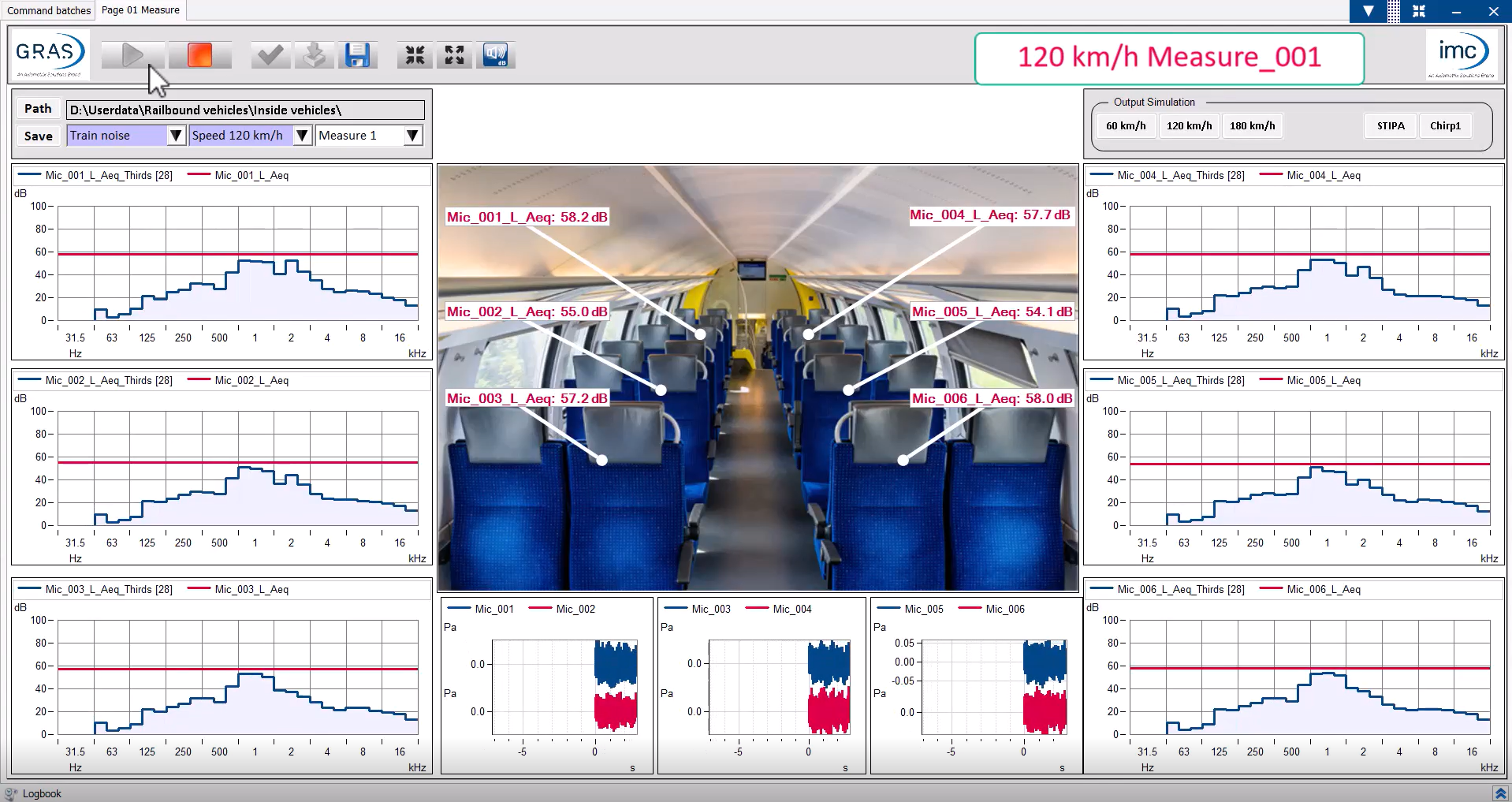
Grâce au logiciel imc STUDIO, tous les modules distribués peuvent être configurés, contrôlés et surveillés à partir d’une seule interface, quel que soit leur emplacement dans le train.
Les ingénieurs peuvent : L’intégration transparente avec imc FAMOS permet un post-traitement détaillé, une évaluation automatisée et la création de rapports personnalisés.
- Visualiser et surveiller les signaux en direct
- Automatiser les mesures et les déclencher en fonction d’événements
- Effectuer les premières analyses pendant les essais
- Détecter instantanément les dépassements de limites
De la mesure au rapport : un flux de travail continu et efficace pour les essais ferroviaires.
S'intègre parfaitement à votre flux de travail de développement
Les systèmes d'acquisition de données imc s'intègrent facilement aux chaînes d'outils existantes :
- Importation de listes de capteurs, de seuils et de métadonnées
- Exportation vers MATLAB®, Python® ou DIAdem™
- Formats standard (MDF4, CSV, HDF5) pour un accès universel aux données
- Liens directs vers les bases de données et le stockage en réseau

Du prototype à l'homologation de série
Au cours du développement d'un train, des centaines de capteurs enregistrent les contraintes, la température et l'accélération sur l'ensemble du véhicule.
Les modules imc CRONOSflex répartis sur le terrain numérisent ces signaux à la source et les transmettent de manière synchrone à l'unité centrale, offrant ainsi une vue d'ensemble en temps réel de l'ensemble des sous-systèmes.
Certification d'un train à grande vitesse
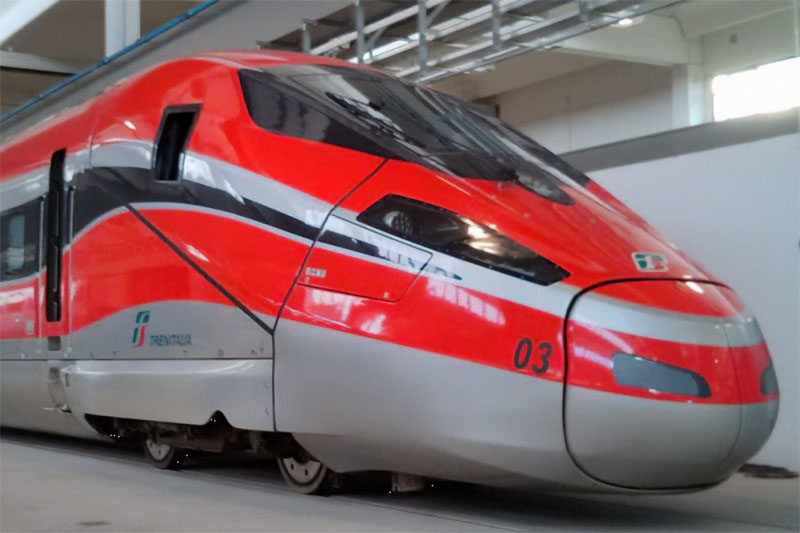
Pour la certification du Frecciarossa 1000, Italcertifer a capturé plus de 300 canaux sur plusieurs voitures à l'aide des modules imc CRONOSflex et CRONOScompact.
Les données d'accélération, de force, de température et de bus ont été enregistrées de manière synchrone à un taux pouvant atteindre 100 kS/s par canal et analysées en temps réel.
Conclusion : Efficacité, robustesse, connectivité
Les systèmes d'acquisition de données distribués d'imc constituent une base solide pour des essais sûrs, efficaces et conformes aux normes des véhicules ferroviaires modernes. Des composants individuels aux rames complètes, ce concept modulaire offre une flexibilité maximale pour un effort d'installation minimal.
Vos avantages :Éprouvé sur le terrain dans des centaines de projets ferroviaires à travers le monde.
- Jusqu'à 70 % de câblage en moins
- Meilleure qualité de signal de sa catégorie grâce à la numérisation à la source
- Synchronisation précise à la microseconde près sur plus de 1 000 canaux
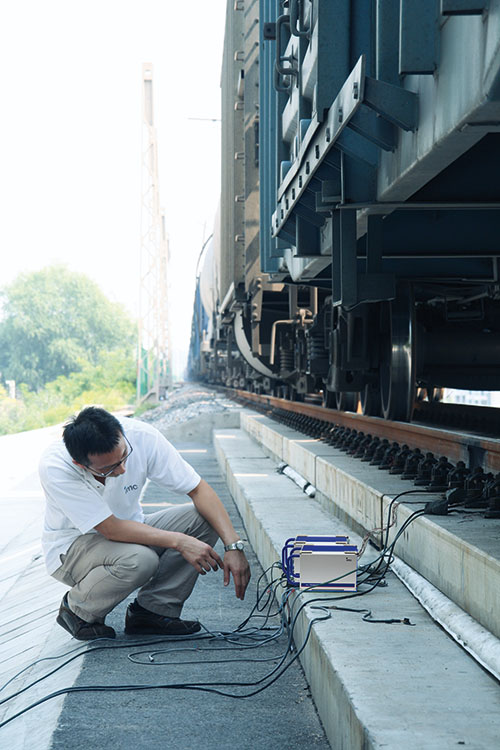
Acquisition précise des données sur l'ensemble du train
Les trains modernes sont des systèmes high-tech complexes : des systèmes de traction haute performance, des bogies sophistiqués, des systèmes de commande et d'alimentation étroitement intégrés, ainsi que des modules de confort pour les passagers, le tout concentré dans un espace restreint. Leur mise à l'essai nécessite des données provenant de centaines de capteurs, installés sur plusieurs voitures, du bogie jusqu'au toit.
Les architectures DAQ centralisées atteignent rapidement leurs limites : les longs câbles analogiques dégradent les signaux, les interférences électromagnétiques (EMI) faussent les données, et l'installation demande du temps et des efforts.
Les systèmes d'acquisition de données distribués d'imc capturent les signaux directement à leur source — de manière synchrone sur tous les points de mesure, grâce à un matériel robuste et une intégrité de signal élevée. Le résultat : une vue précise et globale du véhicule, sans le fardeau d'un long câblage analogique ni la sensibilité aux interférences.
