| Signup for Newsletter |
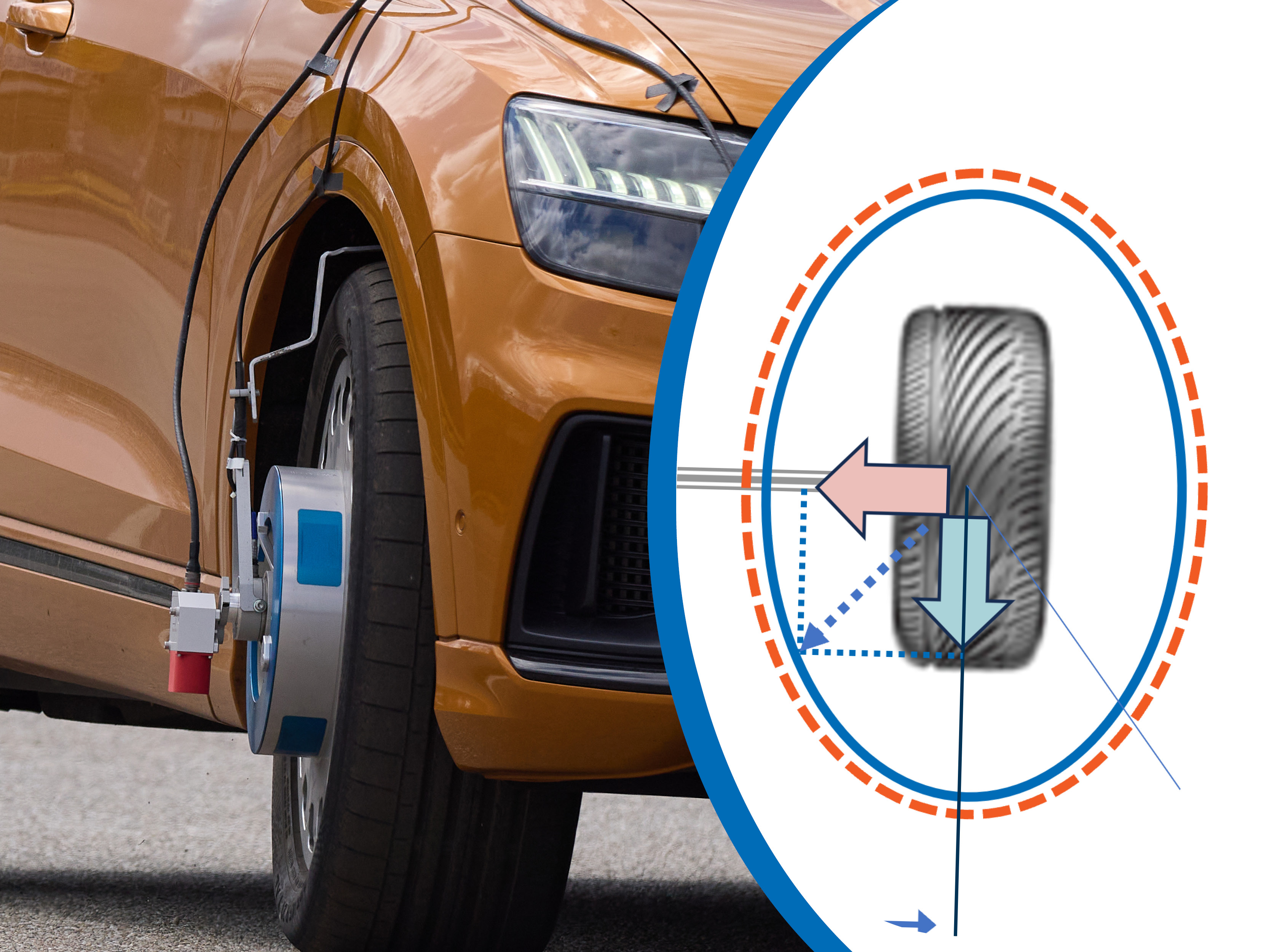
When testing and evaluating vehicle handling and dynamics, many different parameters such as wheel force, steering torque, speed, RPM, vibrations, accelerator pedal position, and many more are recorded to establish causality between them. The data often come from different sensors and systems such as wheel force sensors, steering wheel sensors, speed and acceleration sensors, speed vector sensors, distance sensors, strain gauges, GPS and inertial navigation systems (INS), and field buses such as CAN or FlexRay. This presents some challenges when instrumenting a vehicle under test, as all measured variables must be acquired simultaneously.
Especially on the test bench or on a test track, where in some cases over a hundred channels are recorded at a time, highly accurate real-time measurement data acquisition is necessary for vehicle dynamics testing. Especially when testing and optimizing interconnected systems, such as electronic control units (ECUs)—ranging from simple driver assistants to ADAS and autonomous driving systems—this form of data acquisition is essential.
To deliver reliable measurement results, it’s important to know the basic criteria for precise synchronous data acquisition. Here are 5 key components of successful data acquisition:
1. Time synchronization
Accurate time synchronization of all sensors and data sources is of utmost importance for the evaluation of the results of a vehicle dynamics study. The goal is to evaluate driving behavior and driver assistance system interventions. Precise synchronization allows for accurate alignment of data points and helps avoid timing discrepancies that could lead to faulty analysis. Typically, data in vehicle dynamics tests comes from multiple sensors and systems that have different delay times and synchronization mechanisms. Therefore, it is important to establish synchronicity. Modern data acquisition systems such as the imc CRONOSflex take care of this task. For example, during data acquisition, the imc CRONOSflex DAQ automatically adjusts the channels of all amplifiers to the delay of the slowest amplifier so that the synchronicity of all active channels of a system is maintained.
2. Buffering, data quality and transmission
There is nothing more frustrating than finding out after a measurement that data was actually collected or the data that was collected is unusable? To process the incoming data streams, a data acquisition system should have powerful data storage technology. Using a ring buffer, secure data storage to an internal storage medium or data transfer to an external medium is possible and avoids data loss when processing or transfer delays occur. With the new challenges in the development of electric vehicles, where the measurement technology must be insensitive to electromagnetic radiation, the early digitization of measurement data is an important aspect. This makes sensors and measuring systems more robust to external influences.
3. Scalability and flexibility
The vehicle is fully equipped and ready to be transported to the test track. Suddenly the phone rings and you are told that additional measurement points are needed. Having a flexible approach in data acquisition means you can always give the right answer. Vehicle dynamics testing often goes hand in hand with fatigue tests and other tasks in data acquisition. DAQ systems must therefore not only process data from different sources, but also be scalable, offer connection options for additional channels, and be flexible. For example, your DAQ system should be installable in a spatially distributed manner without compromising synchronization.
Modern DAQ systems with a modular device architecture, such as the imc CRONOSflex, allow any number of measurement modules to be clicked onto a basic device and measurement modules to be installed close to the measurement points in a spatially distributed manner. It also offers seamless integration of the imc WFT-Cx wheel force transducer via a separate measuring module for vehicle dynamics investigations.
4. Hardware and software synchronization
How can all systems and sensors be kept in view simultaneously? To ensure synchronous data acquisition, the hardware and the measurement software should work together seamlessly within a DAQ solution. Since vehicle dynamics tests are typically part of large measurement campaigns, it is advantageous to have centralized control and automation of the measurement solution via software.
The measurement software can be used to set all measurement variables and channels, saving time on site. In addition to the configuration, the central start-up of the data acquisition system and the monitoring of the function of the sensors are among the advantages. Ideally, the configuration and control of the sensors are directly integrated into the system. Modern DAQ systems support this process with further automated functions, for example, by performing a plausibility check of the measured data in real-time to automating measurements with triggers.
5. Calibration and signal processing
What is the cause of unusual measurement data and a questionable assignment of the data to the specific channels in the data analysis software? In most of the cases, especially in complex data acquisition tasks with many different sensors, the sensors in use have not been calibrated due to confusion and the lack of a test equipment database. Proper calibration of sensors is necessary for accurate and reliable measurement. A sensor database is an important basis for mastering the challenge to ensure that the correct sensor and calibration data are available and can be assigned to the appropriate channel within the measurement software. Using RFID tags for sensor, sensors can be conveniently managed within the data base, assigned and sensor data retrieved, and mix-ups and manual incorrect entries can be avoided.
Author: Florian Sailer, imc Business Development Expert Vehicle Dynamics
Did you like this text? For more information on this topic, please visit our website on data acquisition solutions for vehicle testing.
Stay informed: |
| Signup for Newsletter |