• A leader in the test & measurement space
  • Audio Analyzers & Testing by Audio Precision
  • GRAS Sound and Vibration
  • imc Test & Measurement GmbH - productive testing
imc Test & Measurement GmbH
GRAS
  • Produits
    Matériel
    • imc ARGUS<em>fit</em>
    • imc CRONOS<i>flex</i>
    • imc CRONOS<em>compact</em>
    • imc CRONOS-XT
    • imc CRONOS-SL
    • imc C-SERIE
    • imc SPARTAN
    • imc EOS
    • imc BUSDAQ
    • imc CANSAS
    Solutions capteurs
    • Roues dynamométrique WFT- CX
    • Roue dynamométrique WTT
    • Volant dynamométrique
    Solutions de télémesure numérique
    • Dx
    • MTP-NT
    • CTP-NT-Rotate
    • T1
    • TEL1-PCM
    • TEL1-PCM-FLEX
    Bancs de tests
    • Bancs d'essai pour composants
    • Bancs d'essai d'endurance
    • Modernisation de bancs d'essais
    • Bancs d'essai réalisés
  • Logiciels
    imc FAMOS - cadre d'analyse des données
    Logiciel de mesure - imc STUDIO
    imc WAVE - Analyse NVH
    • imc WAVE vibration
    Contrôle à distance - imc LINK
    • Applications mobiles
    • Installations distantes
  • Solutions
    Solutions pour l'industrie
    • Essais de véhicules automobiles
    • Ferroviaire
    • Aéronautique
    • Energie et réseaux
    • Industrie
    • Génie civil
    Solutions générales
    • Solutions bancs de tests
    • Analyse des données de mesure pour la recherche et le développement
    • Tests et analyses de fatigue
    • Extensométrie
    • Test à distance
    • Intégration de bus de terrain
  • Téléchargements
    imc ACADEMY
    • A propos d'imc ACADEMY
    • webinars
    Salons et Expositions
    Téléchargements produit
    • Matériel
    • Logiciels
    • Solutions capteurs
    Actualités
    • Nouveautés
    Presse
    • Communiqués de presse
  • Services et Formations
    Assistance
    System Service
    Qui sommes nous?
    • Conditions générales
  • Contact
    • imc Worldwide
    • +44 7985564945
  • English
  • Deutsch (de)
  • Chinese (Simplified)
  • South Korean
  • French
  • Hungarian
  • Chinese (Traditional) - Taiwan
  • Finnish
  • Spanish

Axiometrix Solutions Family

  • Axiometrix Solutions
  • Audio Precision
  • GRAS Sound & Vibration
  • imc Test & Measurement
  • English
  • Deutsch (de)
  • Chinese (Simplified)
  • South Korean
  • French
  • Hungarian
  • Chinese (Traditional) - Taiwan
  • Finnish
  • Spanish
Se connecter | S'INSCRIRE
  1. imc: des solutions de mesure technologique
  2. Téléchargements
  3. Actualités
  4. Nouveautés

How Do Wind Turbines Work?

04/28/2023

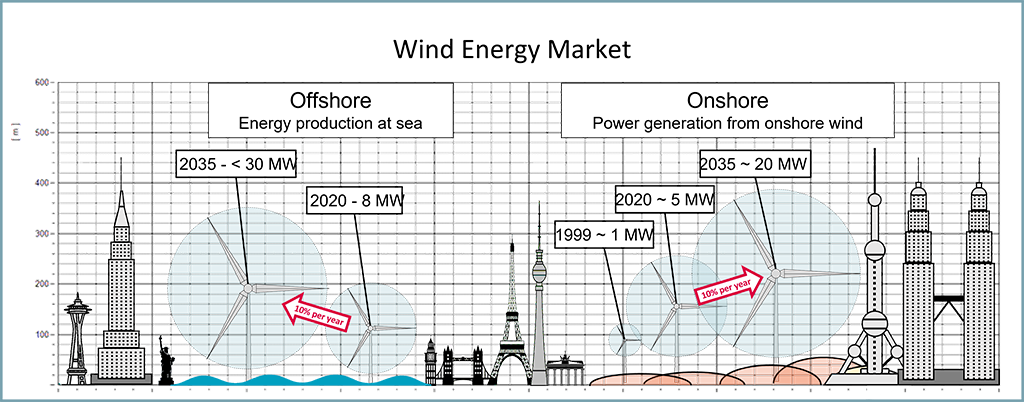
Generating electricity from wind power is generally considered to be efficient and very environmentally friendly. The constant expansion ensures that wind turbines are constantly being improved. But wind turbines differ from one another in terms of how they are built and how they function. For the generation of electricity on land and near the coast (off-shore), towers with a nacelle containing a rotor with a horizontally mounted gearbox are common. However, there are also wind turbines with vertical axes: these are often so-called small wind turbines, which are not so high and have a lower efficiency than a large turbine. These nevertheless have their justification, for example, in natural (protection) areas, where there is nearly no infrastructure, but where for example a parking machine must be supplied with electricity.

Why are tall wind turbines more efficient?

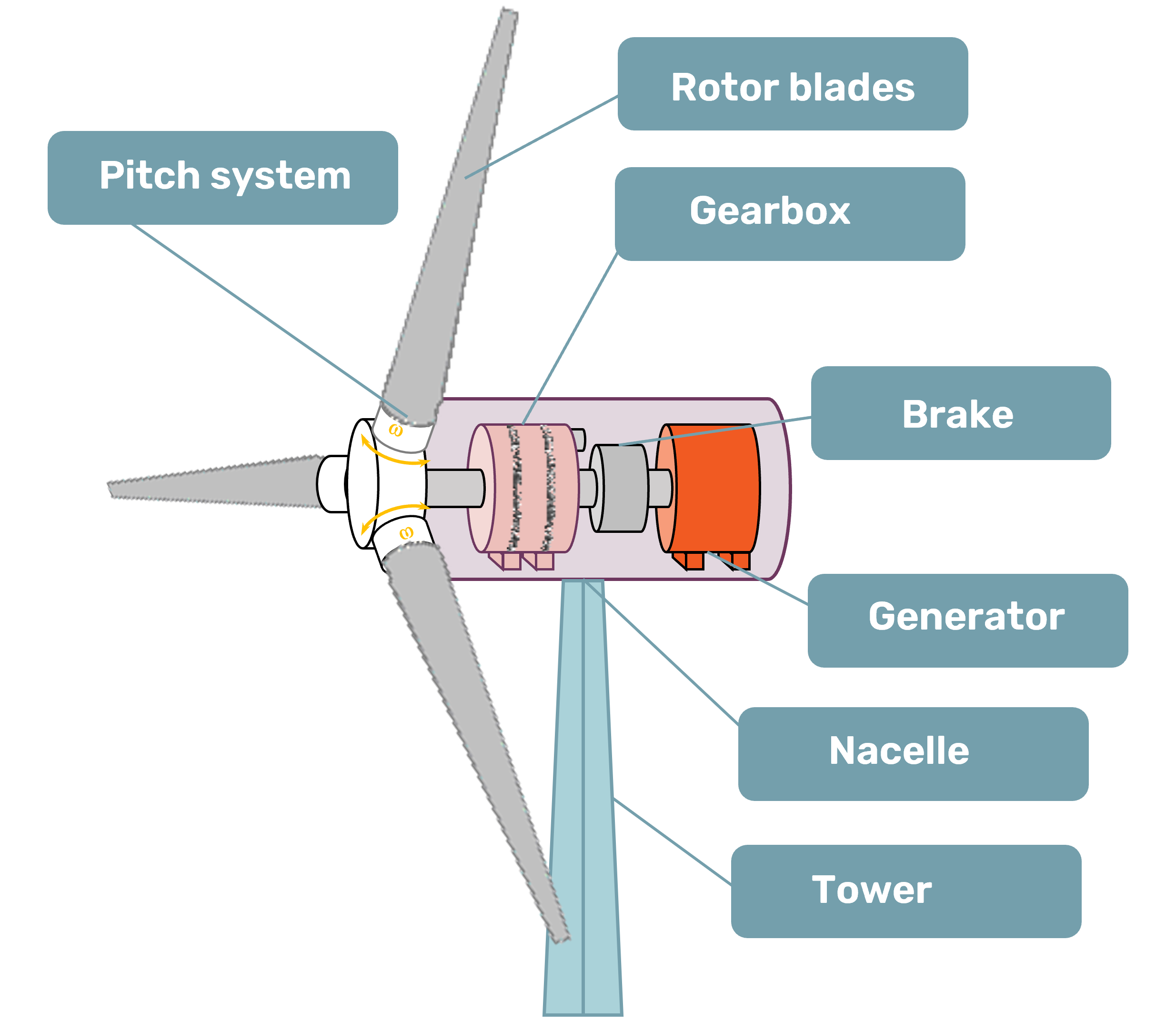
Despite different designs, all wind turbines work on the same principle: When the wind moves the turbine's rotor, the wind's kinetic energy is converted into mechanical energy. The rotor and the electricity generator are located inside the nacelle, which is movably attached to the tower so that it always turns in the direction of the wind and the rotor blades can be driven by the wind. The tower, the supporting element of a wind turbine, provides the necessary height, since here the wind blows more evenly and large rotor blades "harvest" more wind and therefore influence the efficiency of a wind turbine. Furthermore, the tower transfers the static and dynamic loads caused by the movements of the rotor blades and the wind direction tracking to the foundation.

Which components influence the efficiency of a wind turbine?

The rotor blades are one of the most important components of a wind turbine, as their aerodynamic shape and positioning affect the efficiency of the turbine and help to extract as much energy as possible from the wind, which sets the rotor in motion. This is then converted into rotation with the help of a shaft and a gearbox. The gearbox serves to increase the speed from the low speed  shaft to the high speed shaft. The high-speed shaft then drives a generator. The generator converts the rotating motion into electrical energy, which is then fed into the power grid. There are different types of generators that can be used in wind turbines, such as synchronous or asynchronous generators. These operate at different speeds and outputs and are selected according to the requirements of the plant and the available wind energy.

Which components adjust the wind speed to the optimal energy production of the wind turbine?

Modern wind turbines are usually equipped with control systems and sensors. These, on the one hand, measure the wind and adjust the turbine's output accordingly and, on the other hand, optimize rotor speed and position to ensure maximum energy efficiency. The so-called pitch system automatically adjusts the rotor blades to regulate the turbine's output as wind speeds change and to adapt it to different weather conditions. In extreme weather conditions, such as hurricane-force gusts, the rotor blades can be stopped via the rotor brake and the turbine can be shut down completely.

In this way, it is possible to generate energy through the interaction of design, components and environmental conditions efficiently. Measurement solutions from imc Test & Measurement with corresponding hardware and software for data acquisition and data evaluation help to test and optimize wind turbines in this respect and to confirm their safety and environmental compatibility in accordance with standards.

Want to know more about measurement technology and measurement solutions for wind turbines?

Signup for NewsletterRegister for Webinar


More about imc Wind Turbine Testing Solutions

Data Acquisition Systems Measurement Software Sensor Solutions Telemetry Test Stands
FAMOS imc STUDIO imc WAVE imc LINK
FAMOS FAMOS 2026 + AI FAMOS Resources Prices & Editions Try FAMOS
Industries General Applications Automotive Applications
Knowledge Center imc Academy App Notes Whitepapers Tradeshows & Events Webinars Measurement Software News Press Export Declaration
Customer Service System Service Contact Sales General Contact Become a Partner Locations
About imc About Axiometrix Solutions Company Profile CAEMAX KMT Careers Quality Assurance Terms & Conditions Facts
Axiometrix Solutions Logo negativ
imc Test & Measurement is part of Axiometrix Solutions, a leading test solutions provider comprised of globally recognized measurement brands. Productive testing is essential for the success of our customers—hence, our driving force. Since 1988 we have been committed to support industrial innovations with optimal measurement solutions. We are manufacturing our productive test and measurement systems at our headquarters in Berlin, Germany, operating worldwide in Europe, the US and Asia.

© imc Test & Measurement GmbH. All rights reserved.

imprimer Privacy Policy REPORT AN INCIDENT
Follow us:
↑
Loading